Sunday Letter — No. 178 — October 5, 2025
The Lion Tracker's Guide to Life
I can smell the smoke from their fires in the pre-dawn hours.
There is rust on what I imagine are old Land Rover Defenders as they make their way out in the foggy dark, maybe a coffee in hand. Boyd Varty brings me into this big little world with him and two people he clearly loves. They walk through the tall grass of questions. They find some answers.
Varty is a South African wildlife tracker. You join him and his mentors, native Shangaan trackers as they track a lion through thousands of acres.
This is a top 10 book for me and one I always recommend. Usually, I include all of my highlights, but there are more than 130. I’m sharing just my favorites here. Ones like this:
Full of grand visions and the desire to do something great, I often couldn’t find the first small beginning and then the next small beginning.
I couldn’t dial huge possibilities into small practical actions.
I couldn’t trust that doing enough of what needed to be done today would, with time, render a path and an outcome that could be great.
I had to learn to be in the process of transformation, not trying to be transformed. You can’t skip past creating to the creation.
KV: A reminder that the big things come from lots of small things. Each day, do the things. The path will come.
Or this:
We must learn to read the subtle tracks of the body, the way it relaxes and opens when something feels right, the contraction and tightness when we are not where we are meant to be.
KV: It takes courage not just to change but to slow down and notice that the thing you are doing or the people you are doing it with might be wrong. The body has wisdom if we have the wisdom to listen.
Or this:
Watching Renias move now, I am struck by how differently his time in the bush has shaped his outlook. Renias lives outside the deceptions of modern life. Its structured psychological outlook has not affected him, and I know that he is a living clue to a different way of being. He doesn’t concern himself with the attainment of status or wealth. He doesn’t worry about his security in the future or his position within a social group. He doesn’t talk about politics or worry that he isn’t doing enough. To him, time is not money. Productivity is not a reflection of his value. He considers treadmills ridiculous. When it’s time to work, he works. When it’s time to rest, he rests.
Or:
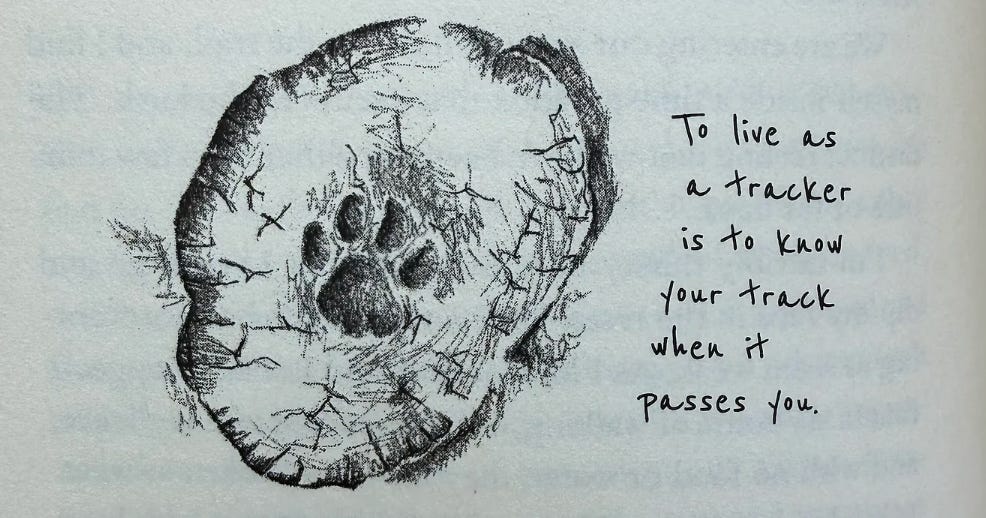
KV: The tracker notices. If we could all just live life as a tracker.
I hope you enjoy these, and hopefully the book, as much as I did. Here are a few more that stopped me.
He has achieved one of the hardest things to achieve in our time: a freedom from judgment about how and who he should be.
Nature doesn’t see status or wealth or social position. It cares only about presence, one’s ability to read the signs, navigate the terrain, and translate the language of the wilderness. Nature is the great equalizer.
The art of the way the tracker sees is the way he can look at the thing he has seen a thousand times and always see something new.
You can’t think your way to a calling. Finding what is uniquely yours requires more than rationality.
We live with our attention directed outward. We focus on the social cues of our culture. We look to others to define our path and value and purpose. We lose ourselves in shoulds.
Shoulds are full of traps—traps laid by society and your limited rules for yourself. No wild animal has ever participated in a should. What you know to do is deeper than that.
The three of us stand on the edge of the bank and look down into the ravine to the tunnels beyond that open like the mouth of a great green beast. We know there are monsters down there. We have reached the moment that asks us about our commitment, our motivation, and our madness. There is a beat of hesitation. We look at each other. Then Renias steps down the bank.
Meaning doesn’t want more; when you’re in deep touch with your wild self, you know you have enough and are enough. From that place of enough, you act in service, because that’s what feeds you.
We have become so unnatural and patterned and socialized that some of us don’t even know what feels good or bad. We operate on autopilot. We are in our lives, but we are not alive.
You can go only as far into the experience of creating life as the limits of your personal belief system will allow.
It is a kind of energy I have witnessed in people who have merged “work,” “mission,” and “meaning.” These people don’t take holidays or need days off. They outwork everyone not from some kind of gritty determination, but from a place of pure pleasure.
He moves in ever-widening arcs, scanning the ground churned by the feet and hooves of hundreds of creatures. He is relaxed. There is no concern that he will miss it. He is not even concerned with finding it. He is completely open to the landscape around him.
The father washes onto the son. He lives inside you as an aspiration, a disappointment, or a fear. Afraid you will never be like him or afraid you will be; he is there in the bones of your emotions. In the voices in your head. In your expectations of yourself. In the shadows of your weakness or strength. No matter how good the relationship, there is a tension between father and son.
The trail was long and the whole time I was on it there was no thought of “me.” The “me” shifted into something much larger than myself. I was completely engaged and forgot about time and all of my own little neuroses. As I disappeared, I felt the flow of the animals and the trees, the birds and the silent presence of the clouds. In this unity everything became innately meaningful. Even my own presence in that moment was free from the past and the future. It was more than enough for me to simply be in the experience. I realized the whole purpose of my life was manifest not as some distant outcome but here, inside an infinite state of enoughness. Before that day, I had always thought that I needed to be somebody in the world. That rhino and the path he walked told me something different: don’t try to be someone, rather find the thing that is so engaging that it makes you forget yourself.
In complete solitude, I stop objectifying myself. In the bush I don’t think of myself on some social hierarchy. I don’t define my value as a comparison with others. The birds and animals don’t judge me. It’s a kind of healing in which I become human again. In complete solitude, we are not a concept of ourselves; we are ourselves.
He is supremely confident. Rather than criticizing and tearing down, the voice inside him motivates and builds.
I don’t know where we are going but I know exactly how to get there might be the motto of the great tracker.
Full of grand visions and the desire to do something great, I often couldn’t find the first small beginning and then the next small beginning. I couldn’t dial huge possibilities into small practical actions. I couldn’t trust that doing enough of what needed to be done today would, with time, render a path and an outcome that could be great. I had to learn to be in the process of transformation, not trying to be transformed. You can’t skip past creating to the creation.
I thought of all the people who had told me that when they knew exactly what they wanted to do, they would leave the soul-destroying thing that they were currently involved with. Obsessed with perfection and doing it right, we want to go straight to the “lion.” We don’t realize the significance of the path of first tracks and how to be invested in a discovery rather than an outcome.
You are your outlook, and that outlook is not universal. It was given to you. The aboriginals used to say of modern life, “It’s three days deep.” In three days in wilderness, you learn what’s important and your mind changes. Your way of being shifts.
There is an immediacy to life in the wilderness that makes so much of what most of us consider important fall away. In the bush I notice how my body falls into a wise rhythm set by light and heat and cold. I move in the dawn, rest through the day, and sleep at night. I eat when I’m hungry. I forget what I look like. I’m surprised to find that the world doesn’t end, and in fact I become happier and less lonely with each day. I transition from endless doing into a steady being. Occasionally, some task that I need to do will arise crisply out of nowhere. I notice it, attend to it, and then drop back into a gentle ease with myself. I understand only in the contrast that the mad momentum of endless doing and its symptomatic emptiness is not how we are meant to live.
As paradoxical as it sounds, going down a path and not finding a track is part of finding the track. Alex and Renias call this “the path of not here.” No action is considered a waste, and the key is to keep moving, readjusting, welcoming feedback. The path of not here is part of the path of here.
You who have longed for and felt called to make a different world. You who have suffered the illnesses of society. You who have risen to the top and found it empty. You with a desire to serve. You who have felt called to nature and to the creatures of the earth. You are the tracker. We are now at an inflection point. We must leave the safety of the village and venture out onto the trail of something wild and uncertain and as yet undefined. We must live on that trail, propelled forward by a set of clues only you will recognize by the aliveness they bring out in you. You must teach yourself to see your track! You are here to live. Your life can be the beginning of a great change; and it must be.
“Track. Track. Track,” Ren has said to me at other times. I understood him to mean find the first track, then the next first track, then the one after that. He does not set out into the unlikely chance of finding a lion in the future. He works with what he has now, in the moment. Joseph Campbell said, “If you can see your whole life’s path laid out then it’s not your life’s path.” In the bush and in life, we don’t get trails fully laid out. We get tremendous unknowns and, if we are lucky, first tracks. Then next first tracks.
Watching Renias move now, I am struck by how differently his time in the bush has shaped his outlook. Renias lives outside the deceptions of modern life. Its structured psychological outlook has not affected him, and I know that he is a living clue to a different way of being. He doesn’t concern himself with the attainment of status or wealth. He doesn’t worry about his security in the future or his position within a social group. He doesn’t talk about politics or worry that he isn’t doing enough. To him, time is not money. Productivity is not a reflection of his value. He considers treadmills ridiculous. When it’s time to work, he works. When it’s time to rest, he rests.
No. 178 — 2006 words — about 9 min